Tidy helper function for causal_forest function
Source:R/helpers-causal-forests.R
causal_forest_handler.RdSplits the data at random into a training and a test set, fits grf::causal_forest() on the training set, and predicts each unit's treatment effect. The data must contain the outcome as Y and the treatment as Z.
Arguments
- data
A data frame with columns
Y,Z, and the covariates named incovariate_names.- covariate_names
A character vector naming the covariate columns the forest may split on.
The share of units assigned to the training set. Defaults to 0.5.
- ...
Further arguments passed to
grf::causal_forest().
Value
data with four columns added: pred (the predicted treatment effect), var_imp (the position in covariate_names of the most important covariate), and the logical indicators train and test.
Examples
library(DeclareDesign)
#> Loading required package: randomizr
#> Loading required package: fabricatr
#> Loading required package: estimatr
library(ggplot2)
#>
#> Attaching package: ‘ggplot2’
#> The following object is masked from ‘package:DeclareDesign’:
#>
#>     vars

dat <- fabricate(
   N = 1000,
   A = rnorm(N),
   B = rnorm(N),
   Z = complete_rs(N),
   Y = A*Z + rnorm(N))

# note: remove num.threads = 1 to use more processors
estimates <- causal_forest_handler(data = dat, covariate_names = c("A", "B"), num.threads = 1)

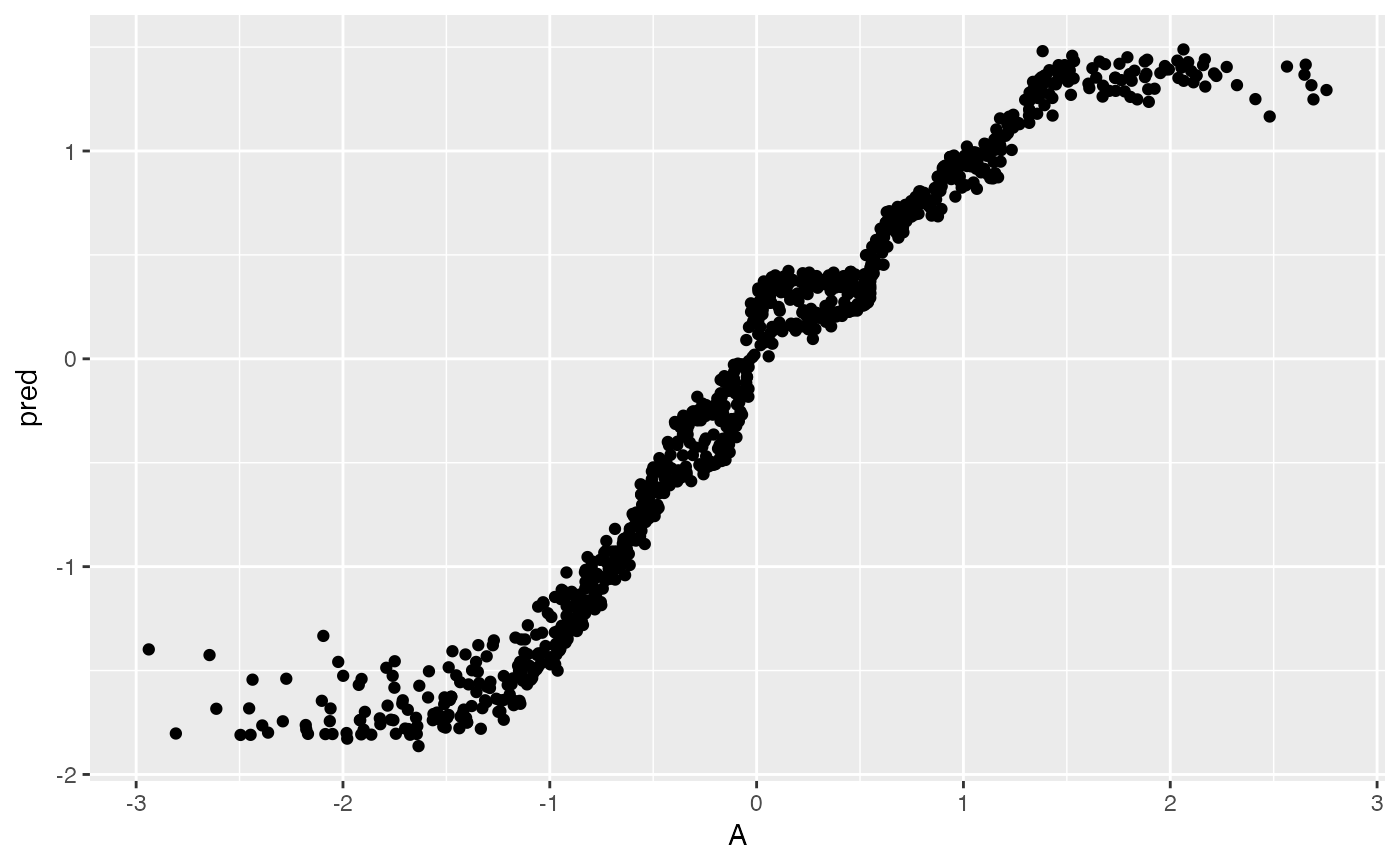
ggplot(data = estimates, aes(A, pred)) + geom_point()